
family guide
Preparing a new caregiver for your child
What to write down, how to run the first visit and what to check afterwards.
In this guide
01The short answer
Give a new caregiver what they need before they’re alone with your child: a one-page plan, a walk through your home, time with your child while you’re there, and a clear way to reach you. Then check in after the first few visits and update the plan.
Back to contents ↑02Before the first visit
Write it down on one page
A caregiver can’t ask you mid-afternoon how your child says “stop”. Put the answers on one page they can read in five minutes:
- Communication: how your child asks for something, says yes or no, or asks for a break, including signs, words or an AAC device.
- Interests and routines: favorite things and topics, and the usual order of the afternoon or evening.
- Sensory preferences: sounds, textures, lights or places that help or bother.
- Difficult moments: the early signs, what helps, what to avoid and when to call you.
- Supervision and safety: how closely to supervise and where; water, doors, roads and food; who can pick up.
- Practical details: meals and snacks, screens, bedtime, house rules, any medication or allergy plan as written by your child’s doctor, and emergency contacts.
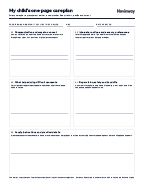
One-page care plan template
Write down what any caregiver needs to know about your child: communication, routines, what helps in hard moments, safety and handoffs.
Download the template1-page PDF · 96 KB
Walk through your home
Show the caregiver the exits and locks, anything that’s off-limits, where snacks and spare clothes are, and the spot your child goes to calm down. Include what doesn’t work, too. It saves a caregiver from learning it the hard way.
Back to contents ↑Want help sorting this out for your family? Send us a question
03The first visit
- Be there for part of it. Let the caregiver watch you run a routine instead of describing it.
- Let your child set the pace. Start with something they enjoy, and keep the first visit shorter than later ones.
- Agree on both handoffs: when you leave and when you return, where they happen and who is responsible for your child.
- Agree on contact. How the caregiver reaches you, how quickly you’ll answer and which situations mean “call now”.
04Outings and pickups
Before the first outing or school pickup, decide together:
- which places are approved, and the route there
- who is allowed to hand your child over, and what the school needs from you first
- whether the caregiver may drive, in which car and with which car seat
- what to bring: snacks, a comfort item, headphones, a change of clothes
05After the first few visits
Ask for a short report after each early visit: what went well, what was hard and anything your child said or did that surprised them. Add what you learn to the one-page plan, and keep it current as your child grows. If a backup caregiver may ever cover, give them the same plan and walk-through.
Back to contents ↑06How Novinway prepares a Care Specialist
With Care Services, this preparation is our job. A clinician develops your child’s Family Care Plan with you, our BCBA completes an in-person assessment, and each Care Specialist assigned to your family is prepared one-on-one for your child before care begins. A supervisor joins in person when care starts, for as many visits as needed, and backups are prepared for your child too. Supervision can return later, and guidance continues throughout care. You don’t repeat intake for each new caregiver.
Back to contents ↑Updated October 2026. General information for families, not tax, legal or medical advice.
Related guides
Guide
Babysitter, nanny or specialized childcare: how to choose
What each option covers, what you handle yourself and when specialized childcare is worth the higher rate.
Guide
Respite options in DC, Maryland and Northern Virginia
County programs, waivers and private-pay care compared, with who qualifies and what each one can’t do.
Guide
The first 90 days after an autism diagnosis
A practical order of steps for families in DC, Maryland and Northern Virginia, with the numbers to call.
Find childcare that
fits your family.
Tell us about your child, the help you need and what matters most to your family. Let’s plan the next step together.
Not ready to book? Send us a question